3 Key Concepts
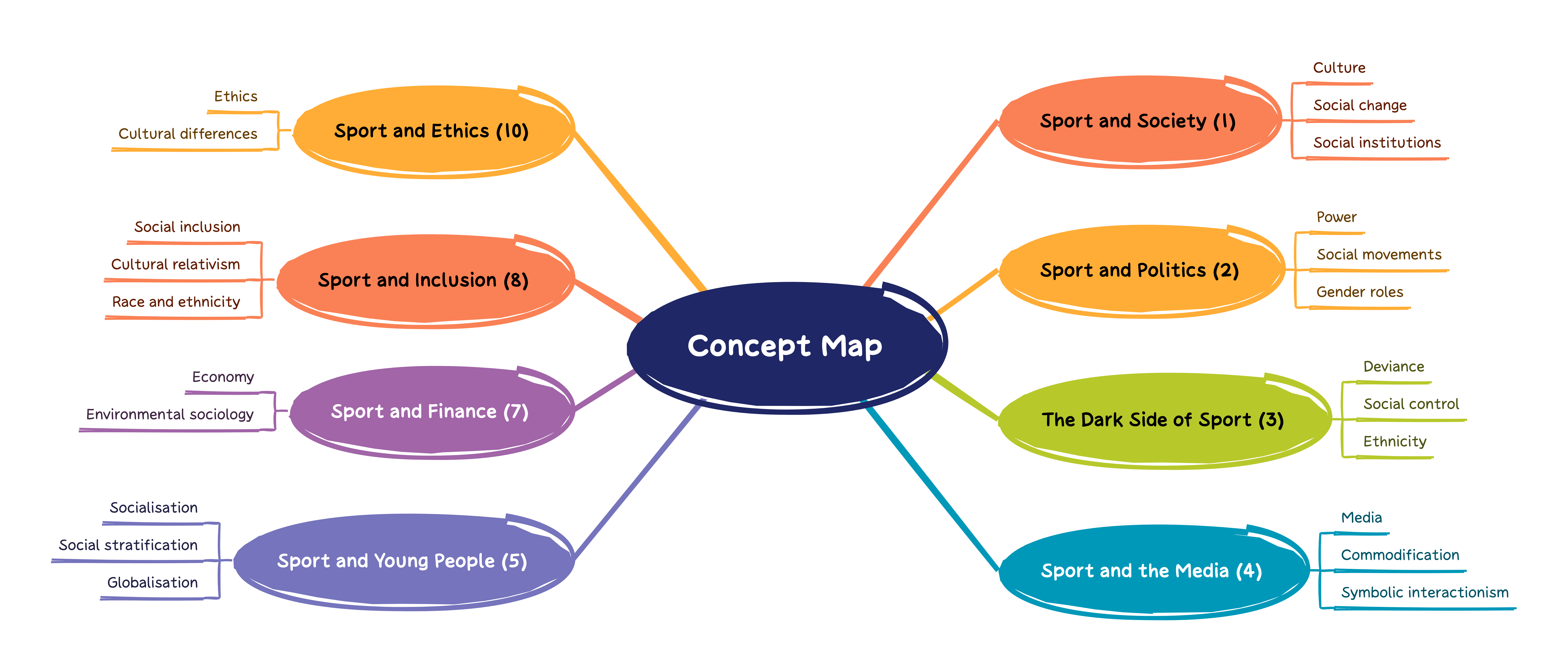
An important part of your learning within this module is understanding a number of key concepts (ideas) that can be applied to different issues and questions within sport.
This page provides a short description/definition of each concept. The number indicates the lecture in which the concept is introduced.
C
Commodification (4)
Increasingly, athletes are ‘commodified’ through endorsements and media portrayals, which can result in challenges like sexualisation and racial stereotyping.
‘Commodification’ in sociology refers to the process by which goods, services, ideas, and even people are transformed into commodities, or items that can be bought, sold, and traded in the market.
The concept highlights how economic value is assigned to aspects of life that were previously not considered in monetary terms, such as culture, human relationships, and natural resources. Sociologists have investigated ‘commodification’ to understand its effects on social relationships, cultural integrity, and individual identity. They have also explored the implications of commodification for inequality, consumer behaviour, and the nature of work and labour in capitalist societies.
Conflict Theory (6)
Conflict Theory is a sociological perspective that emphasizes the role of power, inequality, and social conflict in shaping society. It posits that society is composed of groups with competing interests, and that social structures and institutions are designed to maintain the dominance of powerful groups over weaker ones. Conflict theorists argue that social change is driven by conflict and struggle between these groups, often over resources, rights, and opportunities. They analyze how economic, political, and social inequalities create tensions and contribute to societal change. This perspective is often used to study issues related to class, race, gender, and other forms of social stratification.
Culture (1)
The concept of ‘culture’ helps us understand the cultural significance of sporting rituals and the symbolic meaning of practices like the Olympic Games. In sociology, the term culture refers to the shared beliefs, values, norms, behaviours, and material objects that constitute people’s ‘way of life’.
Culture encompasses both the tangible elements, such as art, tools, and buildings, and the intangible aspects, such as language, customs, and ideologies. It’s learned and transmitted through socialisation, shaping individuals’ perceptions, actions, and interactions within a society.
Culture provides a framework for understanding the world, guiding behaviour, and establishing social order. It is dynamic and constantly evolving, influenced by internal developments and external interactions with other cultures.
Cultural Differences (10)
‘Cultural differences’ in sociology refer to the variations in beliefs, values, practices, behaviours, and artifacts among different societies or groups within a society. These differences can manifest in language, religion, customs, traditions, norms, and other aspects of daily life. Understanding cultural differences is crucial for sociologists to appreciate the diversity of human experiences and avoid ethnocentrism.
Sociologists study cultural differences to explore how they influence social interactions, identity formation, conflict, and cohesion within and between societies, and to develop strategies for fostering intercultural understanding and cooperation.
Cultural Relativism (8)
‘Cultural relativism’ is a concept in sociology and anthropology that posits that a person’s beliefs, values, and practices should be understood based on that individual’s own culture, rather than be judged against the criteria of another culture. This perspective encourages the examination of cultural phenomena within their specific contexts and discourages ethnocentrism, which is the tendency to view one’s own culture as superior. Sociologists and anthropologists use cultural relativism to promote understanding and appreciation of cultural diversity, recognising that what is considered normal or ethical can vary significantly across different societies.
D
Deviance (3)
In sociology, ‘deviance’ refers to behaviours, actions, or conditions that violate societal norms or expectations. It encompasses a wide range of activities, from minor rule-breaking to major crimes, and is context-dependent, varying across cultures and time periods. In the context of sport, it’s a useful concept as we investigate fan violence and hooliganism, especially with regards to understanding the social and psychological factors contributing to such ‘deviant’ behaviours.
Note that, in sociology, the concept of deviance is not inherently negative; it can include innovative or non-conforming behaviours that challenge the status quo
Sociologists use the idea of ‘deviance’ to understand the social processes that define certain actions as deviant, the roles of power and social control in maintaining norms, and the consequences of deviant behaviour for individuals and society.
E
Economy (7)
In sociology, ‘economy’ refers to the social institution that organizes the production, distribution, and consumption of goods and services within a society. It encompasses various systems such as capitalism, socialism, and mixed economies, each with distinct modes of operation and underlying principles. Sociologists study the economy to understand how economic activities and structures impact social relations, power dynamics, and individual behaviour. This includes examining the role of work, markets, corporations, and government policies in shaping economic outcomes and social inequality. The economy is also analysed in terms of its effects on broader societal issues such as class stratification, poverty, and globalization.
Environmental Sociology (7)
Environmental Sociology focuses on the interactions between society and the environment. It examines how social processes, structures, and practices affect the natural environment and how environmental issues, in turn, influence society.
This field explores topics such as environmental degradation, sustainability, resource management, and the social dimensions of climate change. Environmental sociologists analyse the role of economic, political, and cultural factors in environmental problems and advocate for policies and practices that promote environmental justice and sustainability.
They often study how environmental issues disproportionately affect marginalised communities and how social movements address environmental concerns.
Ethics (10)
In sociology, ‘ethics’ refers to the principles and standards that guide the conduct of individuals and institutions in social research and practice. It involves considerations of what is right and wrong, fair and just, and the responsibilities researchers have towards their subjects, communities, and society at large.
Ethical issues in sociology include informed consent, confidentiality, avoiding harm, and ensuring the integrity of research. Sociologists adhere to ethical guidelines to respect the rights and dignity of participants, maintain public trust, and promote the validity and reliability of their findings.
Ethnicity (3)
In sport, the concept of ‘ethnicity’ can be employed in understanding how sports can both bridge and reinforce ethnic and national divides, especially in international competitions.
The term ‘ethnicity’ in sociology refers to a category of people who identify with each other based on shared cultural traits, such as language, religion, customs, traditions, and ancestry.
Ethnic groups are often distinguished by their sense of common history and collective identity. Ethnicity is a socially constructed concept, meaning its significance and implications can vary widely across different societies and historical contexts.
Sociologists explore how ethnicity influences social interactions, group dynamics, and identity formation, as well as its impact on issues like social stratification, discrimination, and political mobilisation. They also examine the role of ethnicity in shaping personal and group experiences within multicultural societies.
F
Feminist Theory (6)
Feminist Theory is a sociological perspective that focuses on understanding and addressing gender inequalities and the ways in which gender structures social life. It examines how patriarchal systems and cultural norms perpetuate discrimination, oppression, and marginalization of women and other gender minorities. Feminist theorists analyse the intersection of gender with other social categories such as race, class, and sexuality, highlighting how these intersections create unique experiences of disadvantage. This theory advocates for social change to achieve gender equity and justice. Sociologists using feminist theory explore topics such as the gender division of labour, representation, body politics, and the impact of social institutions on gender relations.
Functionalism (6)
Functionalism is a theoretical perspective in sociology that views society as a complex system composed of various parts that work together to promote stability and social order. Each part of society, such as institutions, norms, and roles, has a function that contributes to the overall functioning and equilibrium of the system. Functionalists believe that social institutions and processes exist because they serve important functions for society, such as socialization, regulation of behavior, and fulfillment of collective needs. Sociologists using this approach analyze how different aspects of society contribute to its stability and continuity, and how disruptions to this balance can lead to social problems.
G
Gender Roles (2)
The concept of ‘gender roles’ helps us explore the challenges and advancements in gender and sexuality within sport, highlighting the experiences of LGBTQ+ athletes.
In sociology, the term ‘gender roles’ refer to the social and behavioural norms and expectations that society prescribes for individuals based on their perceived gender. These roles dictate (for example) the appropriate attitudes, behaviours, and activities for men and women, often based on traditional notions of masculinity and femininity.
Gender roles are learned through socialisation processes involving family, education, media, and peer interactions. They influence various aspects of life, including career choices, domestic responsibilities, and interpersonal relationships.
Sociologists have studied gender roles to understand their impact on individual identity, social inequality, and the perpetuation of gender-based discrimination and stereotypes. They have also explored how these roles evolve and challenge traditional norms in response to social change and movements advocating for gender equality.
Globalisation (5)
In sociology, the term ‘globalisation’ refers to the increasing interconnectedness and interdependence of the world’s economies, cultures, and populations, driven by advances in communication, technology, trade, and migration. This process results in the blending and clashing of cultures, the spread of ideas, and the creation of global networks and institutions.
Sociologists study globalisation to understand its effects on local and global social structures, cultural identities, economic disparities, and political systems. They also examine how globalisation influences social change, power dynamics, and the experience of individuals and communities in a rapidly evolving world.
M
Media (4)
The media has a significant role in how we encounter and experience sport. In sociology, ‘media’ refers to the various channels and platforms used for communication, information dissemination, and entertainment, including television, radio, newspapers, magazines, the internet, and social media. Importantly, the media plays a crucial role in shaping public opinion, cultural norms, and social values by influencing how information is presented and consumed. Sociologists study media to understand its impact on society, including its role in shaping identity, reinforcing stereotypes, and promoting consumer culture, including within sport. They also examine media ownership, control, and the effects of digital media on social interactions and political processes.
P
Power (2)
The idea of ‘power’ is helpful in explaining the use of sport for nation-building, and its role as a form of soft power in international relations.
In sociology, ‘power’ refers to the ability of individuals or groups to influence or control the actions, behaviours, and beliefs of others. It involves the capacity to enforce decisions, command resources, and shape social structures.
Power can manifest in various forms, including coercive power (through force or threats), authoritative power (legitimised by social norms or laws), and persuasive power (influencing through communication and persuasion).
In sociology, the study of ‘power’ examines its sources, distribution, and effects within society, exploring how power dynamics shape relationships, institutions, and social hierarchies.
R
Race and Ethnicity (8)
In sociology, ‘race’ and ‘ethnicity’ are categories that are used to describe and analyse social identities and group dynamics.
- ‘Race’ typically refers to groups of people who are believed to share distinct physical characteristics, such as skin colour, that are socially significant.
- ‘Ethnicity’ refers to shared cultural traits, such as language, religion, customs, and history, that create a sense of common identity among group members.
Sociologists study race and ethnicity to understand how these social constructs influence individual and group experiences, social stratification, power relations, and identity formation. They also examine the impacts of racism, discrimination, and ethnic conflict, and how societies address issues of racial and ethnic diversity and inequality.
S
Symbolic Interactionism (4)
In contemporary sport, the media often contribute to the construction of athlete identities and fan communities.
‘Symbolic interactionism’ is a theoretical framework in sociology that focuses on how individuals create and interpret meanings through social interactions. This perspective emphasises the subjective nature of social reality, where people act based on the meanings they attribute to objects, events, and behaviours.
These meanings are constructed and modified through interaction with others. Sociologists using this approach study everyday life, communication, and the development of self-concept to understand how social norms and identities are formed and maintained. Symbolic interactionism highlights the importance of symbols, language, and nonverbal cues in shaping human experience and social order.
Socialisation (5)
In sociology, ‘socialisation’ refers to the process through which individuals learn and internalize the values, norms, behaviours, and social skills appropriate to their society. This lifelong process begins in early childhood and continues through various stages of life, involving key agents such as family, schools, peers, media, and religion.
Socialisation helps individuals develop their identity and understand their roles within society, ensuring cultural continuity and social cohesion. Socialisation is used to explore how social influences shape individual behaviour and how social norms are maintained and transmitted across generations.